
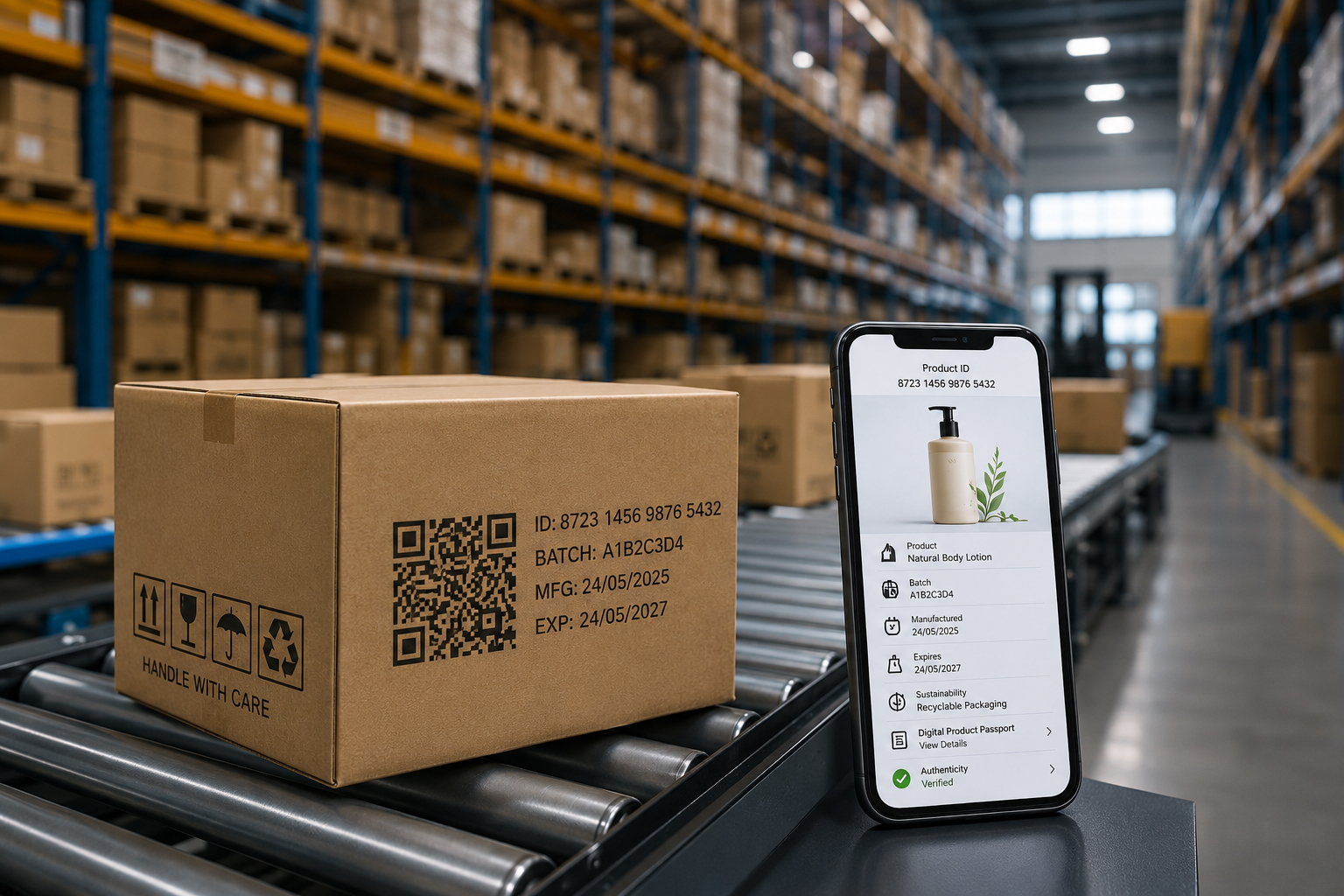
For decades, packaging has served as a static source of information. Product names, ingredients, expiry dates and barcodes have been printed in exactly the same way on thousands, or even millions of identical packs.
That model is changing. Driven by evolving legislation, increasing consumer expectations, and advances in digital technology, manufacturers are moving towards a future in which every individual package carries its own unique digital identity.
At DataLase, we’re seeing growing interest from manufacturers looking beyond traditional coding methods as they prepare for this shift. The conversation is no longer simply about printing a barcode or QR code, it’s about creating a unique identity for every product that can support traceability, transparency and consumer engagement throughout its lifecycle.
From identical packs to unique products
Traditional linear barcodes identify a product type. Every bottle, carton, or pouch within the same product range shares the exact same code. Increasingly, however, manufacturers are embracing serialisation, assigning each item a unique identifier via variable QR codes and other 2D codes. Rather than identifying a product line, these codes identify the individual product itself.
This seemingly simple change unlocks significant opportunities across manufacturing, logistics, retail and the consumer experience. Each unique code can connect to cloud-based information, enabling manufacturers to update product data without changing the packaging itself. Whether it’s sustainability credentials, batch information, product provenance or consumer content, every pack becomes a gateway to real-time information.
Greater visibility across the supply chain
Supply chains have never been more complex. Products routinely pass through multiple manufacturing sites, distribution centres, warehouses, retailers and, increasingly, reverse logistics networks as part of the circular economy.
Unique package identities provide far greater visibility throughout this journey. Manufacturers can precisely identify where products were made, when they were produced, which production line they originated from, and where they are in the supply chain. This improves inventory management, enhances quality control and provides valuable operational insight that simply isn’t possible with static product identification.
As businesses continue to digitalise their operations, item-level traceability is becoming an increasingly valuable source of business intelligence.
Smarter recall management
Product recalls remain one of the biggest operational and reputational risks facing manufacturers. Traditionally, recalls have required withdrawing entire production batches because identifying affected products with sufficient accuracy has been difficult.
Serialisation changes that. By assigning every product a unique identity, manufacturers can quickly identify affected items, determine where they are within the supply chain and communicate more accurately with distributors and retailers. The result is faster decision-making, reduced product waste and greater confidence for both businesses and consumers.
Meeting the needs of tomorrow’s retail environment
The retail landscape is evolving rapidly. Initiatives such as GS1’s Sunrise 2027 programme and the growing adoption of 2D barcodes are accelerating the move towards data-rich packaging that delivers far more than simple product identification.
In the near future, a single QR code may provide access to:
- Product identification.
- Batch and production information.
- Expiry dates.
- Sustainability credentials.
- Digital Product Passport data.
- Authentication and anti-counterfeit verification.
- Consumer engagement and marketing content.
Rather than adding multiple labels or codes, manufacturers will increasingly rely on a single dynamic identifier that supports multiple business functions.
The technology behind unique identities
Creating millions of unique package identities requires more than simply generating different QR codes. Manufacturers need technologies capable of applying high-resolution, variable information accurately, consistently and at production speed, while integrating seamlessly into existing manufacturing processes. This demand is driving innovation across the coding and marking sector.
Alongside conventional ink-based technologies, laser-reactive coding solutions such as those developed by DataLase are helping manufacturers create permanent, high-quality variable information while reducing reliance on traditional consumables.
As packaging becomes increasingly connected, the choice of marking technology will become an important consideration alongside the data itself.
Looking ahead
The move towards unique package identities represents one of the most significant developments in packaging since the introduction of the barcode.
Digital Product Passports, connected packaging, circular economy initiatives and increasing demands for transparency are all accelerating the transition from static packaging to intelligent, data-rich products. For manufacturers, converters and brand owners, the question is no longer whether every package will require its own identity, but how quickly they can implement the systems needed to support it.
At DataLase, we believe this represents an exciting opportunity for the packaging industry. As manufacturers look to balance traceability, sustainability and operational efficiency, technologies that enable accurate, high-quality variable marking will play an increasingly important role in helping every package tell its own unique story.