
For years, packaging has been expected to do more with less. Reduce material use, improve sustainability, increase efficiency and enhance shelf appeal, all while keeping costs under control.
Now another responsibility is being added to the list – becoming a carrier of digital intelligence.
The European Union’s move towards Digital Product Passports (DPPs) signals one of the most significant shifts the packaging industry has seen in decades. According to recent industry reporting, packaging businesses are entering a period of preparation in which product information, sustainability data, and supply chain visibility will increasingly be integrated into every pack produced.
For packaging manufacturers and brand owners alike, this raises an important question: How can physical packaging become a seamless bridge to digital information without adding complexity, waste or cost?
Packaging becomes more than a label
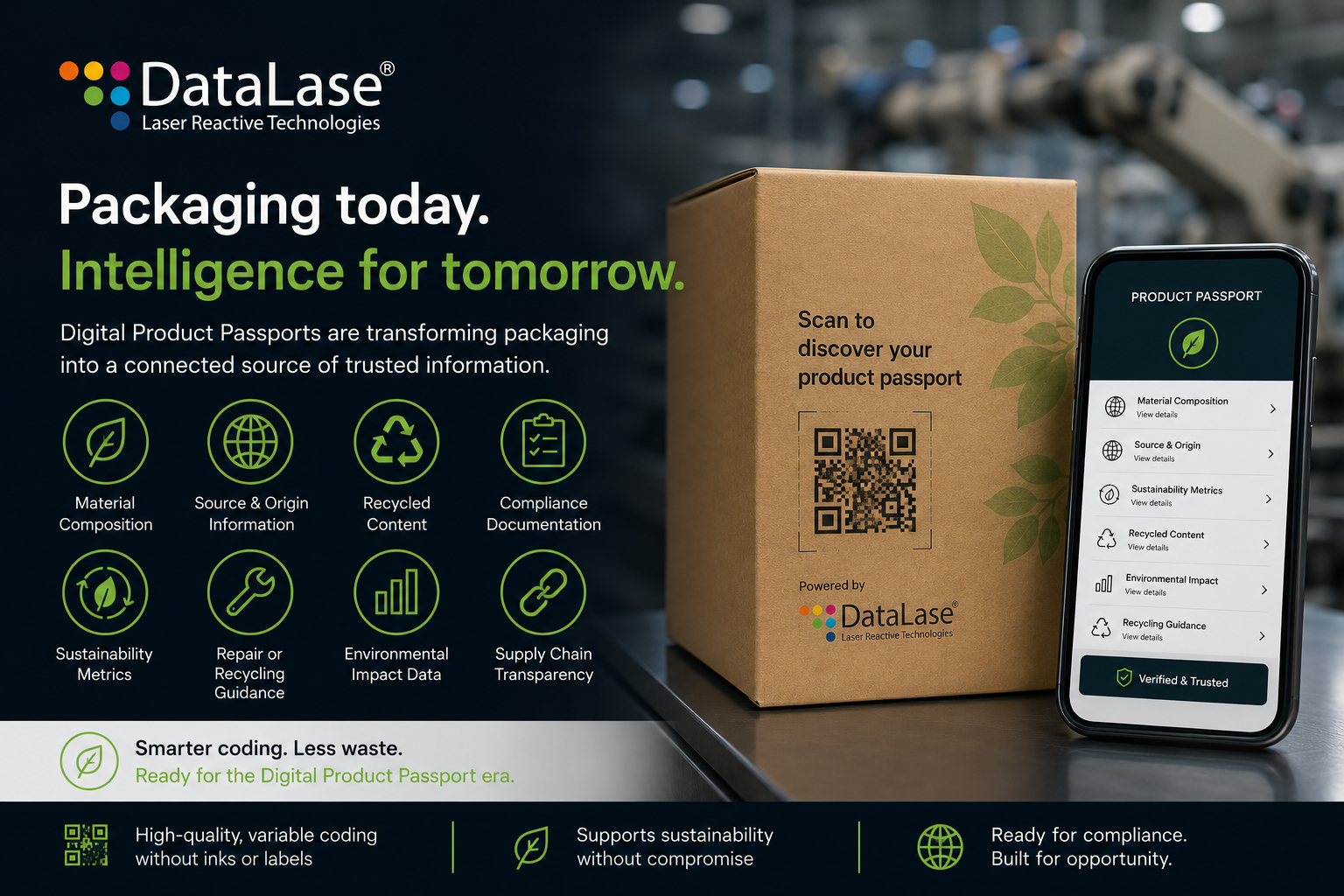
Digital Product Passports are designed to provide accessible information about a product throughout its lifecycle. Rather than existing solely as a physical item, products increasingly gain a digital counterpart containing information such as:
- Material composition
- Source and origin information
- Sustainability metrics
- Recycled content
- Compliance documentation
- Repair or recycling guidance
- Environmental impact data
The concept sits at the centre of broader EU sustainability initiatives and circular-economy ambitions, aiming to improve transparency across supply chains, reduce greenwashing, and support recycling outcomes.
For consumers, this could simply mean scanning a code on a pack to understand where a product came from.
For manufacturers, however, it represents a substantial data challenge.
The rise of intelligent coding
While much discussion around DPPs focuses on databases, standards, and legislation, there is a practical packaging question beneath it all – how is that information connected to the product itself?
Many implementations are expected to rely on QR codes or other digital identifiers linked to cloud-based information systems. These may be either pre-printed static codes or variable QR codes generated uniquely during production, enabling everything from traceability and recycling guidance to dynamic consumer engagement.
Yet introducing additional printed elements onto packaging can create challenges:
- Increased ink use
- Additional label complexity
- Artwork redesign requirements
- Greater inventory variation
Unlike many conventional non-digital technologies, DataLase can support both pre-printed and variable QR codes directly on pack, enabling smarter coding without additional labels, inks or material complexity. With retailers such as Tesco beginning the transition from traditional barcodes to QR-enabled systems, packaging is rapidly evolving into a more connected source of product information.
As packaging becomes more data-rich, manufacturers will increasingly seek solutions that add intelligence without adding material burden.
Data without compromise
The evolution toward digital product passports aligns with a broader packaging trend already underway: using coding and marking technologies to transform packaging from a static surface into an active source of information.
Rather than applying traditional printed information layers, manufacturers are looking for ways to introduce variable information only where and when it is needed.
This is where intelligent coding approaches become increasingly relevant.
Technologies capable of delivering high-quality, variable information with minimal material use can support both operational efficiency and regulatory preparedness. They provide flexibility for unique identifiers, traceability information and future digital interactions while helping manufacturers avoid unnecessary waste.
For businesses already under pressure to meet sustainability objectives, this balance becomes increasingly important.
Compliance today, opportunity tomorrow
The immediate conversation around Digital Product Passports naturally centres around compliance. But history suggests packaging innovations rarely stop there.
Barcodes initially served logistics functions before becoming integral to retail. QR codes moved from industrial use into consumer engagement and marketing. Digital passports may follow a similar journey.
Tomorrow’s packaging may not simply satisfy regulations; it may create entirely new opportunities:
- Enhanced consumer experiences
- Product authenticity verification
- Dynamic content delivery
- Better recycling guidance
- Greater supply chain transparency
- Real-time product insights
The pack itself increasingly becomes a digital touchpoint.
Preparing for a connected future
While implementation standards continue to evolve, the direction of travel is becoming increasingly clear: packaging is moving from static information to connected intelligence.
For brands and manufacturers, future readiness will depend on selecting technologies that can adapt to changing regulatory requirements while supporting wider sustainability objectives.
DataLase’s laser-reactive coding technology is designed around this principle, enabling high-quality variable information directly on the pack, reducing dependence on traditional inks and consumables while helping manufacturers create smarter, more sustainable packaging solutions.
As Digital Product Passports move from discussion to implementation, packaging will increasingly need to communicate more data, more dynamically and more efficiently than ever before.
The question is no longer whether packaging will become more intelligent, but how intelligently that transition is managed.