

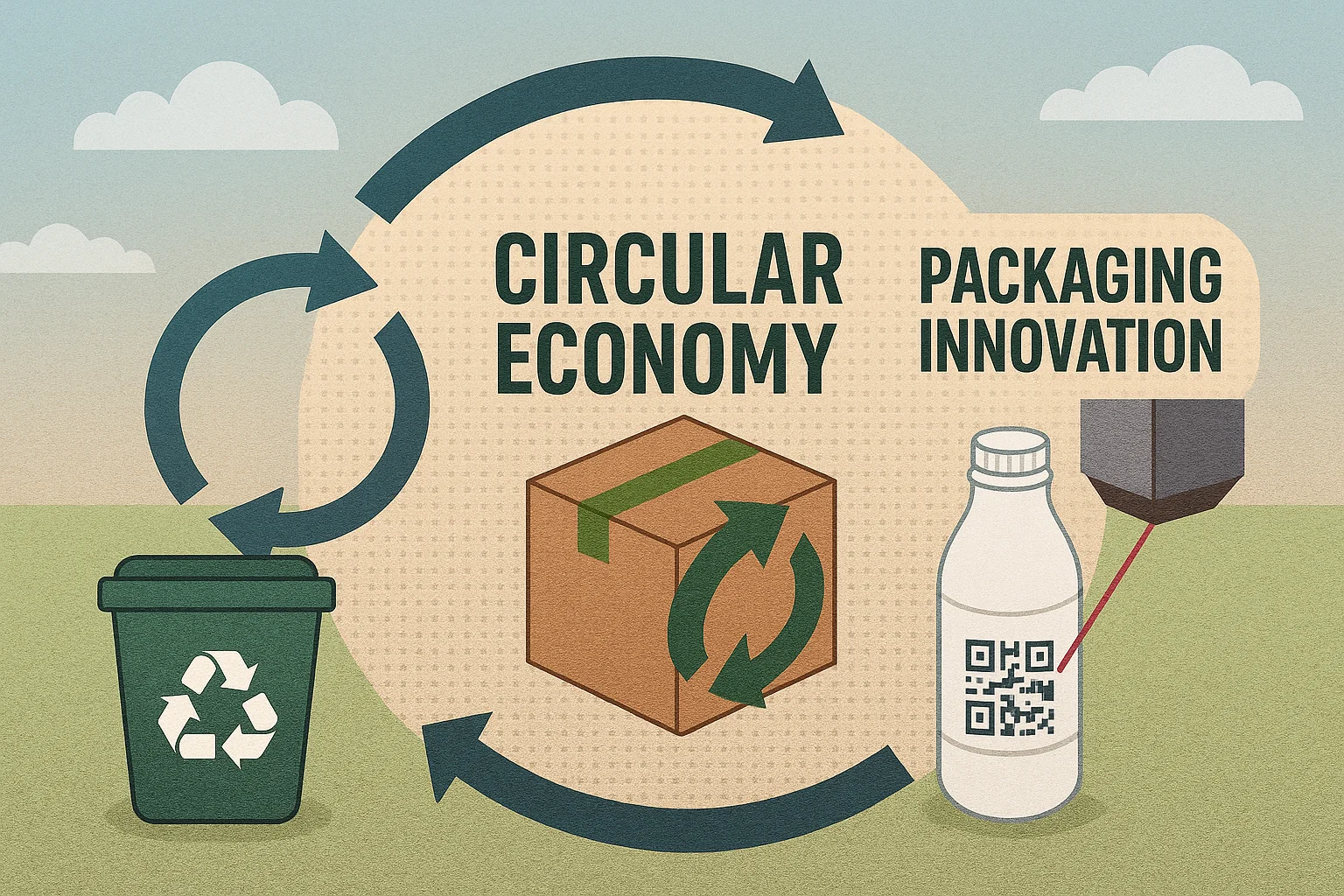
Sustainability and Innovation – The Circular Economy and Packaging’s Role in a Greener Future
In today’s world, sustainability and innovation go hand-in-hand. Businesses across every sector are rethinking how products are made, used and reused, moving beyond simple recycling targets towards designing systems that keep materials in circulation and eliminate waste from the outset.
At the centre of this transformation lies the concept of the circular economy.
For the packaging industry, the circular economy presents both challenges and opportunities. Packaging plays a vital role in protecting and presenting products, but it’s also one of the most visible contributors to waste. The shift to circularity demands that packaging evolves, not just in materials and design, but in the technologies that enable production, decoration and identification.
Closing the Loop
The circular economy replaces the traditional ‘take-make-dispose’ model with one focused on regeneration and reuse. It encourages packaging that can be collected, reprocessed and reintroduced into the value chain, maintaining quality and reducing reliance on virgin resources.
Key strategies include:
- Simplifying structures through monomaterial designs that are easier to recycle.
- Using renewable or recycled content to minimise raw material extraction.
- Introducing refillable and returnable systems that extend the lifecycle of packaging.
- Designing for disassembly so that every component can be recovered.
While these innovations are essential, the way packaging is printed, coded and marked also plays a significant role in determining its recyclability and overall environmental impact.
Printing Smarter for a Sustainable Future
Technologies like DataLase’s photonic printing eliminate the need for liquid inks entirely at the point of packaging or coding. Instead, they use patented laser-reactive chemistry and light energy to create high-contrast marks directly on the substrate surface or sub-surface – ideal for barcodes, variable data, date codes and branding. The result is a permanent, high-quality print that supports sustainability goals without compromising performance.
How Inkless Printing Supports Circularity
By removing inks and coatings from the equation, photonic printing delivers a range of benefits that align perfectly with circular economy principles:
- Cleaner recycling streams – with no ink residues to remove, materials remain purer and easier to reprocess.
- Reduced carbon footprint – the process eliminates consumables, solvents and associated waste.
- Improved operational efficiency – high-speed, on-demand marking integrates seamlessly into existing lines.
- Compatibility with sustainable substrates – works effectively on a wide range of paper, film and biodegradable materials.
This approach not only reduces environmental impact, but also increases packaging integrity and supports brand commitments to sustainability.
Innovation Driving Responsibility
The drive toward sustainable packaging isn’t just about compliance, it’s about future-proofing operations, strengthening brand trust and aligning with evolving consumer expectations. As circularity becomes the new standard, technological innovation will be the differentiator.
By embracing smarter design, renewable materials and next-generation marking systems, packaging manufacturers can make significant strides toward a closed-loop economy. Inkless photonic printing, in particular, represents a practical and immediate step in that direction, enabling both efficiency and environmental progress.
A More Sustainable Tomorrow
The circular economy is redefining how we view materials, waste and value. For packaging, it’s a call to innovate responsibly and create solutions that are not only functional and attractive, but also environmentally intelligent.
At DataLase, we believe that sustainability and innovation must evolve together. Through our photonic printing technology, we’re helping brands and converters reduce waste, improve recyclability and move closer to a truly circular future – one where packaging plays a positive role in protecting both products and the planet.