

How Variable QR Codes are Transforming Product Traceability
When a product leaves the production line, its journey has just begun. It may pass through warehouses, distribution partners and retailers before reaching the customer. If a quality issue emerges along the way, manufacturers need to establish which products are affected, where they have gone and what action is required. The more precisely a pack can be identified and connected to reliable records, the more useful that information becomes.
Variable QR codes can support this more detailed approach to traceability. By carrying information that changes between batches or individual packs, they provide a practical link between physical products and their digital records. For brands and manufacturers, the opportunity extends beyond adding another symbol to packaging: it is about making product identification more useful throughout the supply chain.
From a shared code to a specific identity
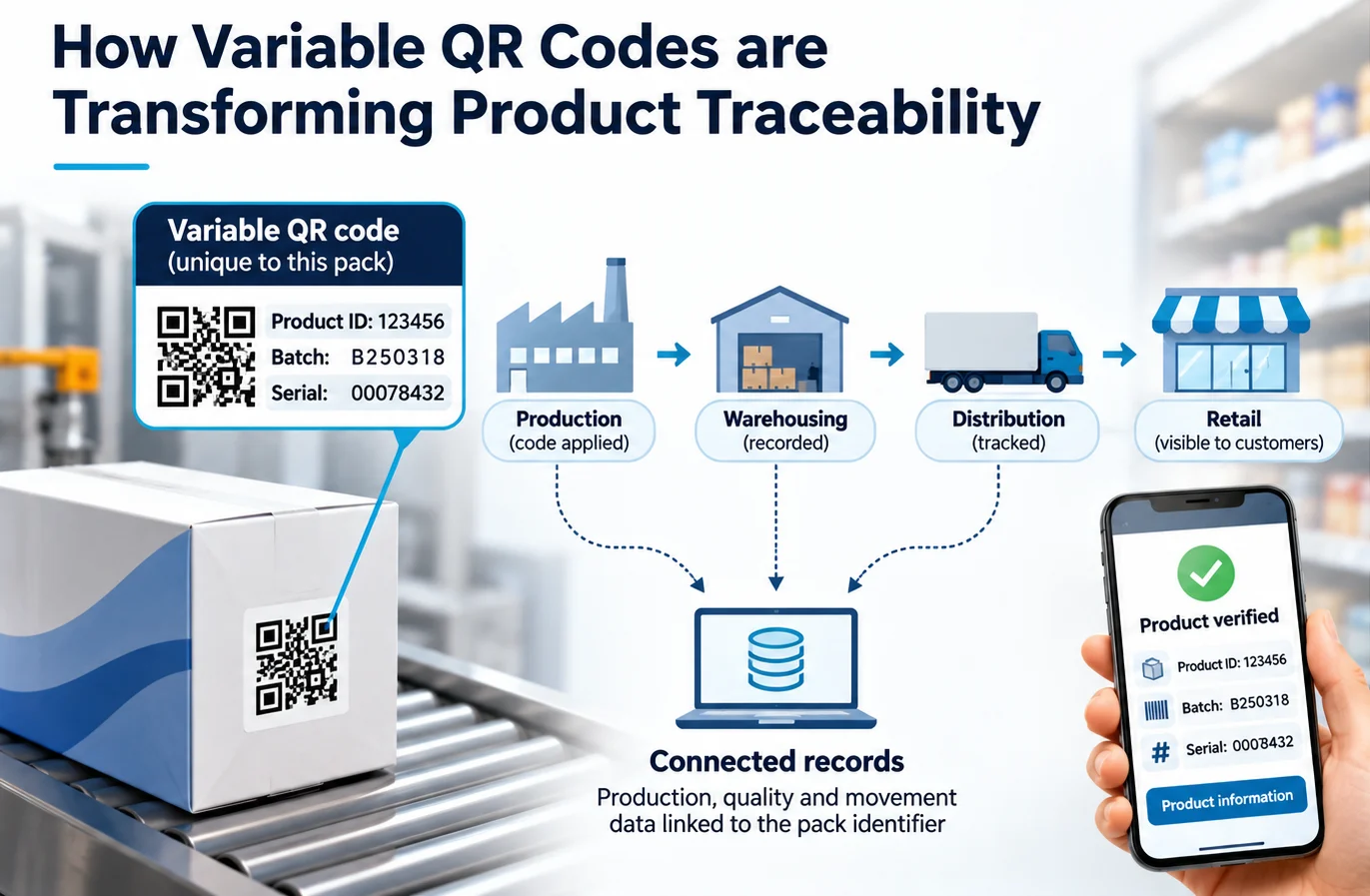
A QR code printed as part of standard packaging artwork will often direct every customer to the same webpage. That can be valuable for product information or marketing, but it does not necessarily identify the batch or individual item being scanned. Variable coding introduces that distinction. A code can contain a product identifier alongside a batch reference or, where item-level identification is required, a unique serial number.
The level of detail should reflect the application. Batch identification may be sufficient to connect products with manufacturing records and support a recall, while serialisation allows individual packs to be distinguished. Importantly, a variable QR code is different from a shared QR code whose destination webpage can be updated. Changing online content does not, by itself, give each pack a unique identity.
Connecting products with their journey
An identifier becomes valuable when it is linked to accurate information. Production records can link a batch or serial number to details such as the manufacturing site, production time, and relevant quality checks. As products move through participating supply chain operations, you can recordadditional events against those identifiers, building a clearer picture of their journey.
The QR code provides a way to access or capture that identity; the connected systems hold and manage the wider record. This distinction matters because a code alone cannot deliver end-to-end visibility. Manufacturers also need consistent data capture, appropriate system integration and agreement with trading partners about the information being exchanged. With those foundations in place, variable codes can help teams investigate discrepancies and retrieve relevant product records more efficiently.
Supporting more focused recalls and investigations
Consider a manufacturer investigating a quality concern affecting a particular production batch. If packs carry an accessible batch identifier linked to distribution records, the business can use that information to help establish the scope of the issue and locate affected stock. Where individual products are serialised and their movements recorded, the investigation can become more granular still.
That precision can support more focused decisions about withdrawal, communication and follow-up. It can also help avoid unnecessarily including unaffected products, where the evidence supports doing so. The outcome depends on the completeness and accuracy of the records, but the principle is straightforward: better identification gives manufacturers a stronger starting point for action.
Strengthening checks and customer information
Unique identifiers can also support product verification. A connected system might check whether a serial number has been issued, whether its status is valid or whether scan activity appears unusual. These checks can help brands investigate suspected duplication or diversion, although a QR code alone is not proof of authenticity: a visible code can be copied, so verification requires suitable controls behind it.
For customers, the same pack identifier can provide access to relevant information, including batch-specific notices or product guidance. GS1 Digital Link offers a standards-based way to connect GS1 identifiers with online resources, helping businesses structure these connections consistently. This creates scope for packaging to serve both operational and customer needs, provided the information is maintained and access is appropriate.
Making variable coding work on the line
Delivering those benefits starts with a readable code on the physical pack. Code size, contrast, placement and the packaging material all influence scanning performance. Manufacturers also need to ensure that the correct data is applied to the correct product and that codes remain usable through the conditions they will encounter. Testing under representative production and handling conditions is therefore essential to implementation.
DataLase supports this physical coding stage through laser-reactive coatings and additives that create a controlled colour change when activated by a laser. The technology produces high-contrast, permanent marks and can be used for variable information, including QR codes, at the point of packing or filling. It provides an inkless marking approach without inks, solvents or ribbons at the coding stage, with the formulation and laser configuration selected for the application.
Building a stronger connection between pack and record
Variable QR codes give manufacturers a practical route to more precise identification, but successful traceability brings together the code, the data and the processes that connect them. Getting those elements right can make packaging a more useful source of information for supply chain partners, quality teams and customers alike.
For DataLase, the focus is on helping manufacturers create the clear, reliable marks that make those connections possible. Whether the requirement is batch identification or individual pack serialisation, choosing and testing the coding approach early helps turn a traceability strategy into a workable production application.
Talk to DataLase about material testing and production trials for variable QR coding on your packaging.